Run Velmonda as an app
- If you opened this from another app, tap the compass (bottom right) to open in Safari.
- In Safari tap Share.
- Tap “Add to Home Screen”.
Install it once and it opens full-screen from your Home Screen, no browser bar.
Add to Home Screen from your browser menu.
Chergui stays in your range from 08:00 to 20:00.
Model ensemble · tuned on 482 measured sessions here · forecast, not measured what that means
Same call as last night
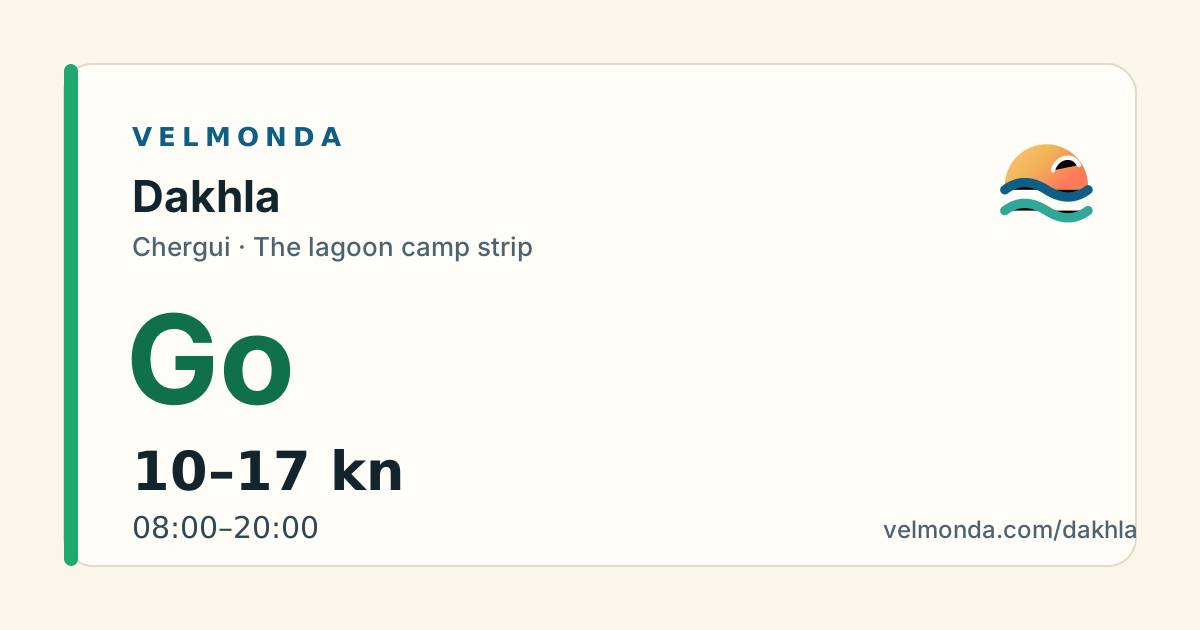
10–17kn 08:00–20:00
Chergui · E/SE · Offshore 156°
08:0014:0020:00
Peak 17 kn at 19:00.
peaks at 17 kn · 537 W/m²
- Water
- 22°
- Air
- 30°
- Suit
- Shorty, or lycra at midday
- Morning
- 24°
- Midday
- 30°
- Afternoon
- 33°
- Evening
- 27°
Wind angle
Blowing off the beach. It will carry you away from the shore. Do not go without cover.
Rising · next low 22:00›
Rising · -0.4 m · range 0.9 m
- Next high
- 16:000.2 m
- Next low
- 22:00-0.6 m
The tide redraws the lagoon twice a day. Low water bares long sandbanks and a long walk out at the camps, and it is the ONLY time the Speed Spot exists: a bank blocks the chop and leaves a glassy strip. Mid to rising tide is the comfortable window on the main lagoon.
Local knowledge
The Speed Spot is a low-tide bank with the wind blowing offshore over it, and the water goes deep immediately on the outside. If you cannot hold ground upwind you drift into the open lagoon with nothing to stop you. Ride it with the camps' boat cover, never alone, and not as a beginner.
The bottom is sand, but it carries shell beds.›
The bottom is sand, but it carries shell beds. Booties save the walk out at low tide and your feet in the shallows.
Cameras & links
- Station Tour d'Eole meter (Windguru 3227)a real meter at the beach, not a forecast
- Station Dakhla Attitude meter (Windguru 107)
- Station Zenith lagoon meter (Windguru 1666)
- Station Dakhla airport METAR (GMMH)the number Velmonda learns from Feeds us
How good is this forecast›
Tuned on 482 measured sessions at this spot, average error 3.0 kn. The correction refits itself nightly. Averaged over every scored hour here, calm ones included. The per-wind rows on the full record are the numbers to plan a session on.
Full track record
About this forecast›
No openly available high-resolution weather model covers this spot (some commercial sites run private local models). The forecast runs on continental and global models, which resolve the coastline more coarsely; expect a wider margin than at a spot with a local model.
No live wind sensor here yet. The number above is forecast, not measured.